
Industrial filter media · Factory-direct B2B supply
Stainless Steel Filter Mesh
YueChu Metal manufactures 304, 316 and 316L stainless steel filter mesh for liquid, air and gas filtration. Choose woven or Dutch cloth in rolls, sheets, discs and custom-cut parts.
- 304 / 316 / 316L options
- Woven and Dutch filter cloth
- Rolls, discs and custom cuts
- Specification and document review
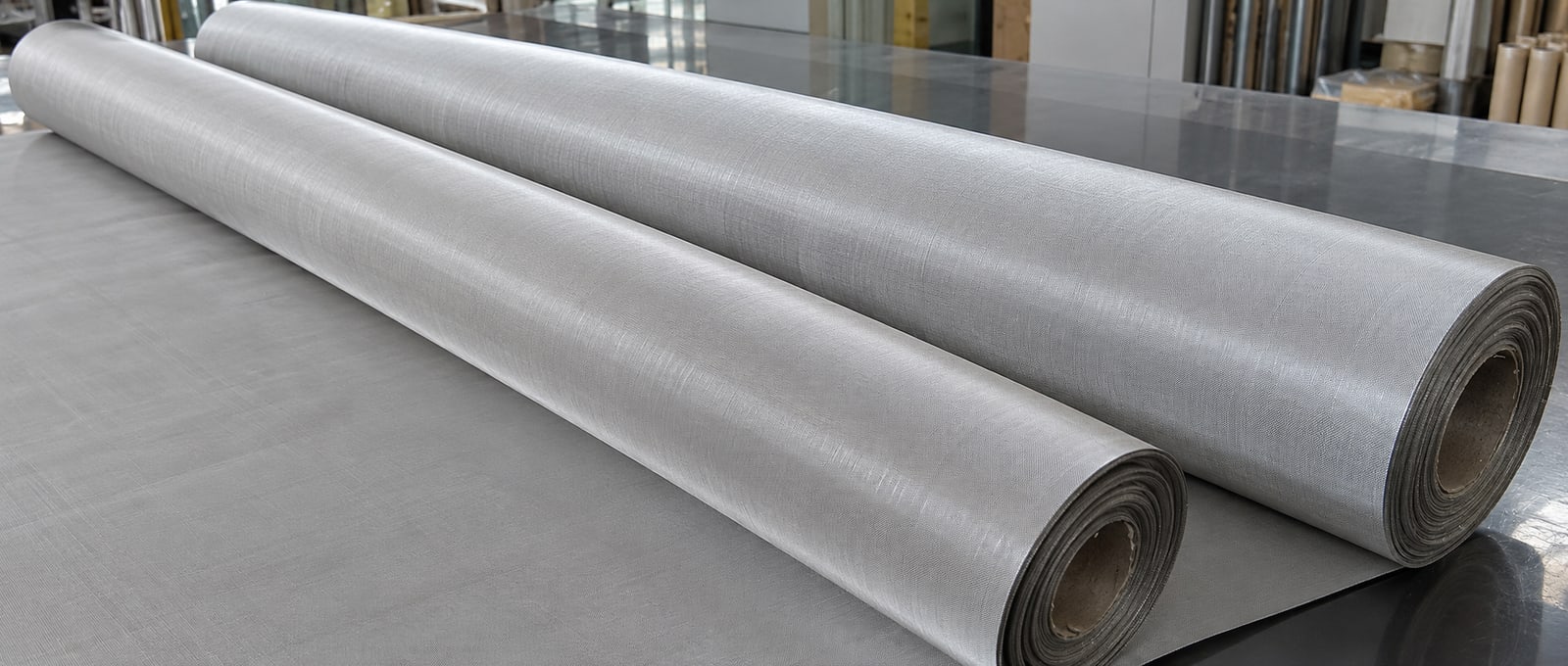
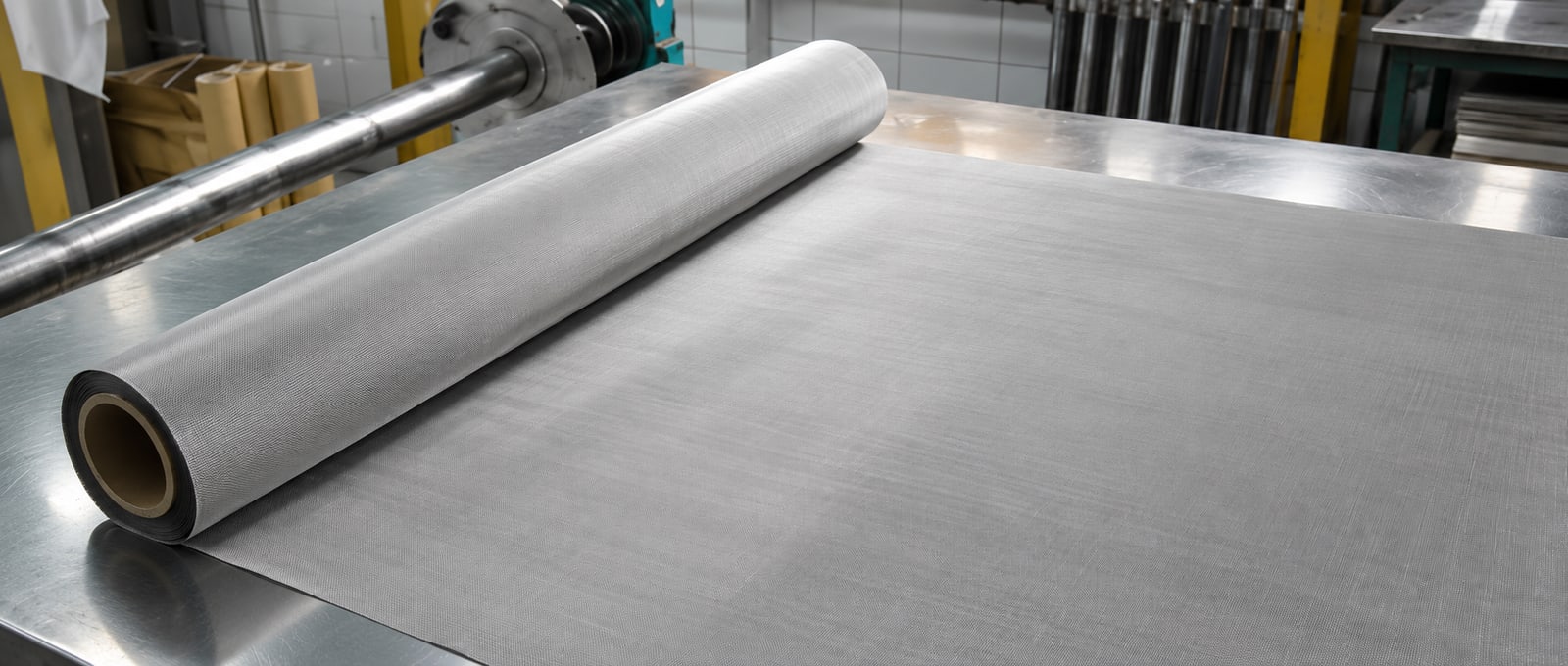
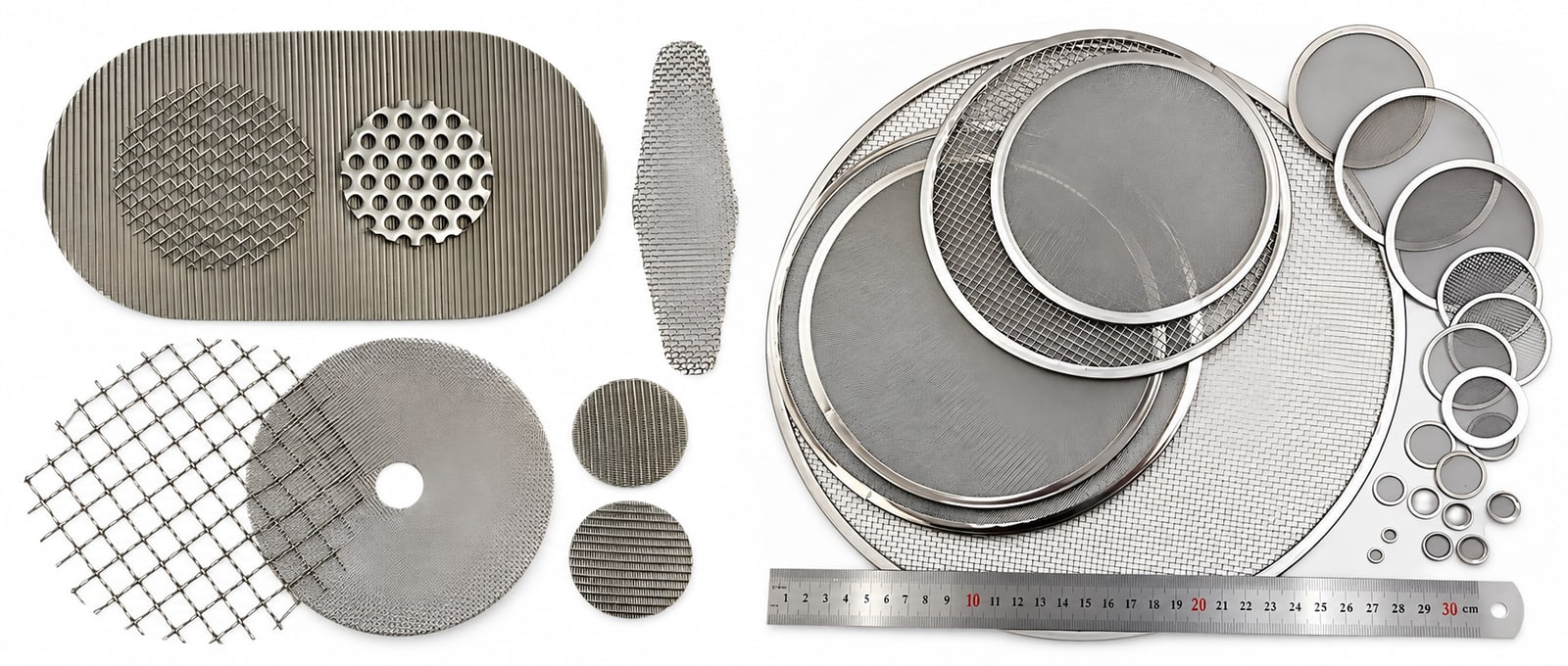
From filter requirement to manufacturable mesh
What is stainless steel filter mesh?
Stainless steel filter mesh is woven wire cloth that screens or retains particles in a process stream. Also called stainless steel filter wire mesh, filtering wire mesh or filter wire cloth, it is selected by its construction, material and required separation performance. A square opening describes geometry; a micron retention rating describes performance under defined conditions.
YueChu Metal supplies filter media and drawing-based mesh parts from Anping, Hebei, China, for equipment builders, distributors, maintenance teams and industrial processors. This page helps you compare media before requesting a roll, cut sheet, filter disc or OEM component.
Choose the construction
Woven stainless steel filter mesh & Dutch filter cloth
Start with the separation duty. Square-weave mesh offers a visible opening for screening and straining; dense Dutch cloth is compared using the complete warp/weft construction and its filtration criterion. Strength, flow, support and cleaning must be considered alongside particle size.
Plain weave filter mesh
A one-over, one-under square weave for screening, strainers and filtration where a defined clear opening is the main selection parameter.
Specify: Mesh count, wire diameter, clear opening and open area.
View construction and specifications →Twill weave filter mesh
A two-over, two-under square weave that can accommodate different wire-to-opening combinations. Compare it when strength, finer construction or forming requirements affect the design.
Specify: The actual wire and aperture combination, support and finished dimensions.
View construction and specifications →Plain & twill Dutch filter cloth
Different warp and weft counts and wire diameters form a dense filtration path. Compare plain Dutch and twill Dutch when particle retention drives selection.
Specify: Warp × weft count, both wire diameters, retention criterion and test method.
View construction and specifications →Reverse Dutch filter mesh
A reversed warp/weft arrangement considered for filter strips, belts and demanding process filtration, including polymer melt applications.
Specify: Complete construction, strip dimensions, tracking or edge requirements and operating conditions.
View construction and specifications →A support mesh or backing layer may be needed to carry differential pressure. The fine filtration layer and the structural support should be specified separately. For a broader construction comparison, see stainless steel woven wire mesh.
Material selection
304, 316 & 316L stainless steel filter mesh
Choose the alloy for the actual process medium and cleaning conditions. The same opening can be made in different materials; changing the alloy alone does not change the geometric aperture.
304 / 304L filter wire cloth
A common starting point for general industrial screening, clean process streams and equipment with manageable corrosion exposure.
Confirm: Cleaning chemicals, temperature and fabrication. Specify 304L when the low-carbon grade is required, and request supporting material documentation.
Material specifications and verification →316 / 316L filter wire cloth
Molybdenum-bearing grades considered for chloride exposure, chemical processing and more demanding cleaning environments.
Confirm: Medium, concentration, temperature and contact time. 316L is a low-carbon option for applicable welded parts; it is not a universal solution for every corrosive fluid.
Material specifications and verification →For SS316 stainless steel woven filter wire mesh, state whether Type 316 or 316L is required and identify the standard on the purchase order. Handheld XRF can help distinguish molybdenum-bearing alloys, but cannot verify the carbon content needed to establish an L grade. See the 304 vs 316 selection guide for a comparison.
For high-temperature filter media, include operating temperature, atmosphere, pressure, support and thermal cycling. A room-temperature material designation or alloy temperature figure is insufficient to define the service limit of a complete mesh component.
Mesh count, aperture and retention
How to specify micron stainless steel filter mesh
Mesh count is not a micron rating. For equal-count square weave, the clear opening depends on both the number of wires per inch and wire diameter. Dutch cloth has a different filtration path and needs its own construction and rating definition.
Square-weave opening (mm) = 25.4 ÷ mesh count per inch − wire diameter (mm)
Opening (µm) = opening (mm) × 1000
Calculated open area (%) = [opening ÷ (opening + wire diameter)]² × 100
Open area is a geometric comparison, not a pressure-drop prediction. Viscosity, media thickness, support, fouling and flow conditions also affect performance. The square-weave calculation assumes equal pitch and wire diameter in both directions.
| Mesh / inch | Wire Ø · mm | Opening · mm | Opening · µm | Opening · inch | Open area |
|---|---|---|---|---|---|
| 50 | 0.208 | 0.300 | 300 | 0.01181 | 34.9% |
| 100 | 0.114 | 0.140 | 140 | 0.00551 | 30.4% |
| 200 | 0.053 | 0.074 | 74 | 0.00291 | 34.0% |
Geometry reference: Cleveland Wire Cloth specification catalogue. Apply this relationship to square cloth only; use the Dutch rating and test-method guide for filter cloth.
20 Micron Stainless Steel Filter Mesh
Tell us whether 20 µm means a clear opening or a retention target. For a nominal rating, state the required efficiency; for an absolute rating, state the test and pass criterion. Then compare media with the necessary flow and support.
A search for “635 mesh 20 micron filter” does not define a complete product. A 635-mesh square pitch is about 40 µm; the remaining opening depends on wire diameter. Validate the proposed construction before production.
50 mesh per inch, 300 micron opening
A 50-mesh square cloth has a 0.508 mm pitch. A 300 µm opening implies about 0.208 mm wire, as in the calculated example above. A different wire size produces a different aperture and open area.
If the request says “8 mm stainless steel wire mesh filter”, confirm whether 8 mm is the clear opening, a pitch or a part dimension. Millimetre-scale openings normally describe coarse screening or a supporting layer.
- Clear aperture
- The geometric space between adjacent wires in an open weave. It is not a measured particle-retention efficiency.
- Nominal retention
- A particle size linked to a stated retention efficiency and test conditions. The efficiency must accompany the number.
- Absolute rating
- A limiting particle-size criterion under a defined test. Record the test procedure, conditions and acceptance criterion for a comparable specification.
Fast technical selection
Square-Woven Filter Mesh Reference Sizes
Compare selected 10–200 mesh combinations and add a reference to your inquiry. YueChu manufactures to confirmed specifications; grade, finished size, tolerances, quantity and availability are agreed at quotation. Openings below are geometric dimensions, not Dutch filtration ratings.
| Mesh count | Wire dia. | Openingmm / µm | Typical construction | |
|---|---|---|---|---|
| 10 × 10 Mesh | 0.635 mm | 1.905 mm1905 µm | Plain weave | |
| 20 × 20 Mesh | 0.406 mm | 0.864 mm864 µm | Plain weave | |
| 40 × 40 Mesh | 0.254 mm | 0.381 mm381 µm | Plain weave | |
| 60 × 60 Mesh | 0.191 mm | 0.232 mm232 µm | Plain weave | |
| 80 × 80 Mesh | 0.140 mm | 0.178 mm178 µm | Plain weave | |
| 100 × 100 Mesh | 0.114 mm | 0.140 mm140 µm | Plain weave | |
| 150 × 150 Mesh | 0.066 mm | 0.103 mm103 µm | Plain weave | |
| 200 × 200 Mesh | 0.053 mm | 0.074 mm74 µm | Plain weave |
Nominal opening: calculated for square mesh as 25.4 ÷ mesh count − wire diameter. Actual dimensions and tolerances must be confirmed for each order.
Dutch weave uses different warp and weft constructions and is quoted separately.
Request by opening or by an existing specification
The reference table is a starting point, rather than the limit of custom production. For finer or coarser cloth, send the required opening and wire diameter, or an existing specification. For 20, 50 or 100 micron filtration, also identify how retention must be assessed. For Dutch mesh, provide both warp and weft counts and wire diameters instead of one square-mesh number.
You can specify millimetres or inches and metres or feet. Include the units with every dimension. If you only have a target micron value, send the process conditions so we can review suitable constructions.
Media to finished dimensions
Filter mesh rolls, sheets, discs & custom-cut parts
As a stainless steel filter wire mesh cloth supplier, YueChu can quote raw media and drawing-based parts for downstream filter fabrication. Choose the form that fits your cutting, assembly or maintenance process.
Filter mesh rolls
For repeated cutting or filter production. Specify usable width, length, grade, weave, winding and core requirements.
Sheets & cut-to-size pieces
For screens and replacement media. Supply width × length, quantity, dimensional tolerance and edge condition.
Slit strips & filter belts
For narrow media or continuous equipment. Specify slit width, length, edge quality and any joint or tracking requirements.
Stainless steel filter mesh discs
For filter packs and equipment inserts. State outside diameter, any centre hole, layer arrangement, quantity and drawing tolerance.
Cylinders, tubes & filter caps
Drawing-based parts require diameter, length, seam or end details and support design. Construction and fabrication are reviewed before quotation.
OEM filter components
For repeat equipment builds. Send the drawing revision, material specification, inspection requirements and forecast quantity to establish an agreed part definition.
Filter cloth vs cartridges, pleated filters and bags
A stainless steel wire mesh filter cartridge or pleated filter cartridge is an assembly. Layer count, pleat geometry, seam, end caps, seals and support can be as important as the cloth. Filter tubes, cylinders and caps likewise need a drawing. Send the complete design for feasibility review rather than specifying the media alone.
For high-temperature filter bags or reusable coffee-filter components, include shape, joining method, edge finish, cleaning conditions and the required performance test. We confirm the manufacturable assembly and documentation scope in the quotation.
Air, liquid and solid separation
Industrial stainless steel wire mesh filter applications
The best filter mesh is the construction that meets your separation, flow, cleaning and lifetime requirements. An industry name alone is not enough to choose the grade or micron rating.
Water & process-liquid filtration
Strainers, prefilters and liquid–solid separation. State the suspended solids, required opening or retention, flow, allowable pressure drop and cleaning cycle.
Oil, fuel & hydraulic strainers
Compare viscosity at operating temperature, contaminant size, differential pressure and support. Confirm compatibility with the actual fluid and additives.
Air & gas filter screens
For defined screening or prefiltration duties. Specify particle size, face velocity, cleaning and support. A mesh aperture alone does not establish a HEPA or other air-filter efficiency class.
Food, beverage & coffee equipment
Screening, ingredient separation and reusable filter inserts. Define food contact, cleaning method, taste or solids requirements, finished edges and applicable documentation.
Chemical & process equipment
Match alloy and construction to the medium, concentration, temperature and pressure cycle. Specify seals, supports and any project-specific acceptance test for assembled parts.
Polymer, mineral & maintenance duties
Polymer melt filtration may call for Dutch media and supporting layers; mineral or MRO replacements may need a coarser screen. Include abrasion, existing part geometry and replacement conditions.
Reusable media: plan cleaning and replacement
Define whether the mesh will be backwashed, brushed, ultrasonically cleaned or chemically cleaned. Check cleaning-agent compatibility, damage to fine wires, residual contamination and the condition of seams or supporting layers. Set an inspection and replacement criterion for the actual service rather than assuming indefinite reuse.
A comparable purchase specification
Filter mesh inspection, standards & material documents
Agree inspection with the construction and use. A reference to an ASTM or ISO document identifies a scope and requirements; it does not establish product certification or demonstrate a batch result.
ASTM E2016
General industrial woven wire cloth: specify the applicable geometry and inspection requirements. Special-purpose filter cloth has a separate specification.
ISO 9044:2016
Industrial woven wire cloth with square apertures: terminology, permissible errors and inspection. Its scope excludes pre-crimped and welded screens.
ASTM E2814
Industrial woven wire filter cloth, including Dutch constructions: agree construction and the applicable acceptance criteria.
ASTM E3278
Bubble point pressure testing of woven wire filter cloth. Any pore-size conversion requires defined test conditions and a conversion factor.
What to confirm for the order
- Material: specified grade and product-form standard, such as ASTM A580/A580M stainless steel wire, with the required material record.
- Geometry: warp/weft counts, wire diameter, square aperture or Dutch construction, usable dimensions and agreed tolerances.
- Filtration: retention definition, sampling, test conditions and acceptance criterion when performance testing is required.
- Finished parts: drawing revision, edge, seam, flatness or roundness, support and assembly requirements.
- Identification: specification labels, quantity, packing and the traceability information required for reorders.
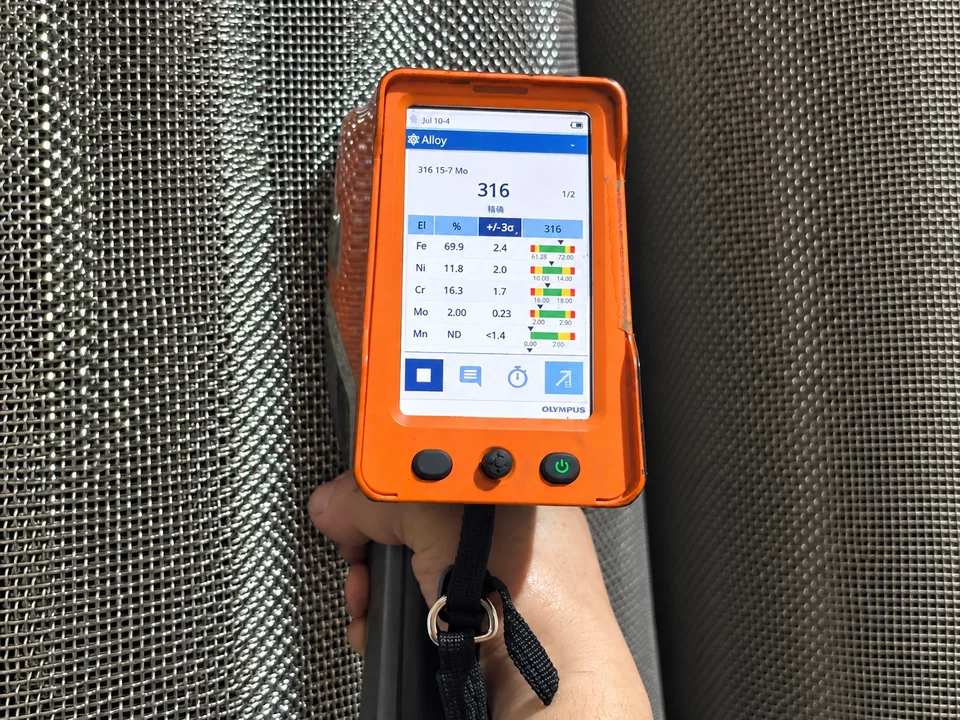
Material verification has a defined scope
This XRF photograph shows alloy identification of a sample. Request the material evidence appropriate to the order; low-carbon grades require evidence beyond handheld XRF. Explore 316 material verification and 304 chemistry references.
CoC, MTC / MTR and test reports
A supplier certificate of conformity, a mill material certificate and a sample-specific filtration report answer different questions. Tell us which document, issuer, traceability and test scope your project needs. Availability and any inspection cost are confirmed before accepting the order.
Food-contact and destination requirements
NSF/ANSI 51 addresses food-equipment materials and finishes; 304 or 316 chemistry alone does not establish NSF certification. CE marking applies only when relevant EU legislation requires it. Provide the intended product, destination market and exact requirement for document review.
Technical contact: Zhan Xiao · Quality Control Manager, Quality Control Department. Technical sources checked . For supplier background, visit the About YueChu Metal.
Samples, trial orders and repeat supply
MOQ, wholesale quotations, lead time & packing
Samples and small quantities
Request a sample, cut piece or trial quantity with the intended specification. Stock material and custom weaving have different minimums. We confirm availability, sample cost and any cutting or setup charge for the requested order.
Wholesale & repeat OEM orders
For wholesale SS316 woven filter mesh or repeat filter-cloth orders, agree the complete construction, finished dimensions, drawing revision and inspection scope. A stable specification makes future quotes and replacement batches comparable.
Lead time and export delivery
Tell us your destination in Europe, North America, Australia or another market, and your delivery target. Timing depends on wire procurement, weaving, cutting, inspection and packing. The quotation identifies the shipping basis and which freight, duties or taxes are included.
Packing for the product form
Rolls need suitable cores and protection against deformation; fine sheets and discs need support and separation. Specify moisture protection, labels, handling limits and any crate or pallet requirements with the order.
What affects the price?
Grade, wire diameter, weave, finished area, cutting yield, fabrication, quantity and inspection determine the quote. Compare the same geometry and supply form when reviewing stainless steel wire mesh filter suppliers. Material, processing, documents and freight should be clear in the commercial offer.
Prepare a useful inquiry
Request a stainless steel filter mesh quotation
If you know the specification, send it directly. If you only know the application, describe the process and target separation. For a replacement filter screen, include the existing drawing, labelled dimensions or sample information.
- Grade and construction: 304 / 316 / 316L; plain, twill or Dutch.
- Geometry or performance: mesh count + wire diameter, or target opening / retention with its definition.
- Finished size: width × length, disc diameter or component drawing; units and edge requirements.
- Process: medium, temperature, flow, allowable pressure drop, support and cleaning.
- Commercial details: quantity, sample request, destination, delivery target and required documents.
Buyer questions
Stainless Steel Filter Mesh FAQ
What is stainless steel filter mesh?
Stainless steel filter mesh is woven wire cloth used to screen or retain particles in a process stream. Square-weave cloth is specified by mesh count, wire diameter and clear opening; Dutch filter cloth is specified by warp/weft geometry and an agreed filtration criterion. YueChu supplies media and drawing-based cut parts for industrial buyers.
Is filter wire mesh cloth the same as a finished filter?
Filter wire mesh cloth is the media. A cylinder, cartridge, strainer or pleated filter may also need supporting layers, joints, end caps and seals. Send the complete drawing and performance requirements when requesting an assembled component; availability is confirmed for that construction.
Is 100 mesh the same as 100 micron?
No. For equal-count square mesh, clear opening in mm is 25.4 divided by mesh count per inch, minus wire diameter in mm. A 100-mesh example with 0.114 mm wire has a calculated opening of 0.140 mm, or 140 microns. Dutch retention cannot be determined by this square-mesh formula.
How do I specify 20 micron stainless steel filter mesh?
State whether 20 microns means a geometric opening, a nominal retention with a stated efficiency, or an absolute limit under a defined test. Include the fluid or gas, flow, temperature, pressure drop and support. Compare the complete square or Dutch construction before fixing a mesh count.
Does 635 mesh always mean a 20 micron filter?
No. 635 mesh gives a pitch of about 40 microns for an equal-count square weave. The clear opening still depends on wire diameter; 20 micron wire would give a calculated 20 micron opening. That calculation is not evidence of manufacturability or a certified retention rating.
Can I request 50 mesh with a 300 micron opening?
For equal-count square mesh, 50 mesh has a 0.508 mm pitch. A 0.300 mm opening would imply approximately 0.208 mm wire. Provide both values for production review; choosing a different wire diameter changes the opening and open area.
Should I choose 304, 316 or 316L filter mesh?
304 is common for general industrial duties. 316 contains molybdenum and is considered for more demanding corrosion exposure. 316L is the low-carbon variant, relevant to some welded components. Select by actual medium, concentration, chlorides, temperature and cleaning; confirm the specified grade with material documentation.
Can you supply stainless steel mesh for air, water or oil filtration?
Yes, subject to selection for the operating conditions. Provide the contaminant size, required retention or opening, flow, temperature, pressure drop, cleaning method and support geometry. Screening media and a complete filter assembly have different specification requirements.
Can I order samples, small quantities or wholesale filter mesh?
Request the sample or trial quantity together with the specification and destination. Sample availability, minimum order quantity, cutting charges and lead time depend on material, weave, dimensions and inspection needs. Repeat or wholesale orders can be quoted against the same approved specification.
Do you manufacture custom filter discs, tubes and cylinders?
YueChu can review drawings for filter discs, cut pieces and fabricated mesh parts. Provide outside dimensions, seam and edge details, support, layer arrangement, tolerances and quantity. Complete cartridges, pleated elements or bags require a separate assembly review rather than a quotation for cloth alone.
Is stainless steel filter mesh automatically CE or NSF certified?
No. CE marking depends on whether the product is covered by applicable EU legislation requiring it. NSF/ANSI 51 concerns food-equipment materials and finishes; choosing 304 or 316 does not automatically establish certification. Provide the destination and exact requirement so the documentation scope can be confirmed.
What should I send a stainless steel filter mesh supplier for a quote?
Send grade; weave; mesh count and wire diameter or target opening/retention; roll, sheet or part dimensions; quantity; process medium and operating conditions; required standard and documents; destination and delivery target. For a replacement, include the existing drawing, labelled specification or sample information.
- Materials
- 304, 304L, 316 and 316L
- Construction
- Plain, twill, Dutch and reverse Dutch
- Specify by
- Mesh + wire diameter, or target retention + test method
- Forms
- Rolls, sheets, slit strips, discs and drawing-based parts
Made to your specification · Request a quotation
Technical DataProduct parameters & construction details
- Materials
- 304, 304L, 316 and 316L
- Construction
- Plain, twill, Dutch and reverse Dutch
- Specify by
- Mesh + wire diameter, or target retention + test method
- Forms
- Rolls, sheets, slit strips, discs and drawing-based parts
- MOQ / lead time
- Confirmed for the selected specification and quantity